The Hidden Cost of a Single Negative Review (And Why Ignoring It Is a Mistake)
For many business owners, a single negative review feels insignificant. It is easy to dismiss it as an outlier or assume that a strong overall rating will neutralize the impact. In practice, that assumption is often wrong.
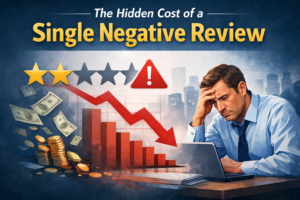
Online reviews influence trust, visibility, and purchasing behavior in ways that are not always obvious or immediately measurable. In some cases, one highly visible negative review can undermine months—or years—of brand-building, marketing spend, and customer goodwill.
This article breaks down the real cost of a single negative review, why traditional responses are not always enough, and how thoughtful review management and online reputation management strategies help protect long-term business value.
Why One Negative Review Carries Outsized Weight
Consumers do not process reviews in a balanced or purely rational way. Behavioral research consistently shows that negative information has a stronger psychological impact than positive information of equal intensity.
Studies published through the National Institutes of Health demonstrate that people are more likely to remember and prioritize negative experiences. When applied to online reviews, this means a single critical comment can disproportionately influence perception—even when surrounded by positive feedback.
From a buyer’s perspective, negative reviews are often viewed as more “honest” or revealing. Shoppers tend to read them carefully, looking for warning signs or confirmation of risk. This dynamic gives negative reviews far more power than their numerical weight might suggest.
The Trust Gap Created by a Single Bad Review
Trust is fragile in online environments. According to research from the Pew Research Center, a large majority of U.S. consumers regularly consult online reviews before making purchasing decisions. Reviews are no longer supplemental information; they are foundational to trust formation.
A single negative review can introduce doubt at the exact moment a potential customer is deciding whether to move forward. Even if the review reflects a rare issue, readers have no context for how representative it is. In the absence of certainty, many choose the safer option: a competitor with fewer visible risks.
This trust gap is especially damaging for:
Local service businesses
Healthcare and professional services
High-ticket or long-term purchase decisions
In these cases, hesitation often results in abandonment rather than further research.
The Measurable Revenue Impact
Negative reviews do not just affect perception; they affect revenue.
A widely cited study from Harvard Business School found that a one-star increase in rating can lead to a 5–9% increase in revenue. The inverse is also true: losing a star can materially reduce earnings.
What makes this especially concerning is how easily averages can shift. A single negative review can:
Pull an overall rating below a key threshold (often 4.0 stars)
Change how a business compares to competitors in search results
Reduce conversion rates from otherwise qualified traffic
Revenue loss from negative reviews is rarely attributed directly in analytics dashboards. Instead, it appears as declining lead quality, fewer inbound calls, or slower sales cycles—making it easy to underestimate the true financial cost.
Why Ratings Below 4.0 Matter So Much
Consumer behavior research consistently shows that buyers use star ratings as a shortcut for quality and safety.
According to findings from the Spiegel Research Center, purchase likelihood drops significantly when ratings fall below 4.0 stars. This threshold functions as a psychological filter. Businesses below it are often excluded from consideration entirely, regardless of other strengths.
A single negative review can be enough to:
Push a newer business below 4.0
Stall momentum during early growth stages
Undo gains from recent positive reviews
This is why review management must focus not only on volume, but also on visibility and context.
Visibility and the Silent SEO Impact
Online reputation management and search visibility are closely linked, particularly for local businesses.
While search engines do not disclose exact ranking formulas, reviews influence:
Click-through rates from search results
Engagement signals on business profiles
User confidence when choosing between similar listings
The U.S. Department of Commerce has highlighted the growing role online reviews play in consumer decision-making across industries. In practice, businesses with visible negative reviews often experience fewer profile clicks, even when rankings remain unchanged.
Lower engagement creates a feedback loop:
Fewer clicks signal reduced relevance
Reduced relevance limits visibility
Lower visibility further reduces opportunity
This dynamic means a negative review can have lasting effects even if it does not immediately impact rankings.
Why “Just Responding” Is Not Always Enough
Responding to negative reviews is widely recommended—and often necessary—but it is not a universal solution.
Professional, calm responses can help in cases where:
The complaint is legitimate
The issue has been resolved
Future customers value transparency
However, responses do not remove the original content. Highly visible negative reviews often continue to rank prominently, especially if they attract engagement.
In cases involving:
False claims
Reviews from non-customers
Conflicts of interest
Off-topic or policy-violating content
A response may inadvertently legitimize a review that should not exist at all.
This is where negative review removal becomes an essential part of comprehensive review management.
When Negative Review Removal Is the Right Approach
Not all negative reviews are valid, and platforms recognize this. Many reviews violate published guidelines or consumer protection standards.
The Federal Trade Commission classifies fake or misleading reviews as deceptive practices. This underscores an important point: removal is not about silencing criticism, but about enforcing fairness and accuracy.
Reviews may qualify for removal when they:
Are written by individuals with no genuine experience
Contain demonstrably false statements
Are posted by competitors or former employees
Include harassment, hate speech, or irrelevant content
Effective online reputation management involves knowing when to manage sentiment and when to pursue legitimate removal channels.
The Long-Term Risk of Ignoring the Problem
Ignoring a negative review rarely makes it disappear. Over time, unresolved reviews can:
Become reference points for future reviewers
Be cited or echoed by others
Gain visibility through engagement and recency signals
This compounds risk. What began as a single review can shape a broader narrative if left unaddressed.
Strategic review management focuses on prevention, monitoring, and timely intervention—before issues escalate into long-term reputation damage.
What Proactive Businesses Do Differently
Businesses that protect their reputations effectively tend to follow a few consistent practices:
Monitor reviews regularly, not reactively
Evaluate reviews for policy compliance, not just sentiment
Address legitimate feedback while challenging invalid content
Treat online reputation management as an ongoing process
This approach reduces uncertainty, preserves trust, and supports sustainable growth.
Final Thoughts
A single negative review is rarely “just one review.” It can influence trust, visibility, conversion rates, and revenue in ways that are easy to underestimate and difficult to reverse.
While professional responses and customer engagement are important, they are not substitutes for informed review management strategies. In cases where reviews are misleading or violate platform standards, negative review removal may be the most effective and appropriate solution.
For businesses navigating these challenges, working with experienced professionals can help ensure that online reputation management efforts are both ethical and effective—protecting what has already been earned rather than constantly repairing preventable damage.